

Fae
Fae have always existed in our world either as sprites or tricksters, fairies or fair folk, they are revered and feared in equal measures…
Although it has long been understood by the supernatural community that they are not of this world, but rather that they would transit between their world and ours.
And so it was for millennia, with Fae cropping up in every Iliad, scripture, tome, and carving worldwide; seen either as gentile sprites or as vengeful imps. Transiting between worlds, the Fae would live side-by-side with humans and supernaturals, some integrating themselves into society, others on the fringe, but always with the ability to return home.
This changed, however, in the early 18th century, when the Slighe, or Passage, closed – Leaving thousands of Fae trapped in our realm. Cut off from their home and their ways of life, the remnant Fae have departed from the rules and rigors of their ancestors, who they consider to have abandoned them. Generations of young fae have grown up having never known their home, and are fully integrated into life here in our world.
Culture
The true origins of the fae remain a mystery, largely unknown even to the fae themselves, who lack knowledge of their beginnings or creator. Similarly, little is understood about fae religious practices, which seem to vary across the world.
In the realm of the Fae, relationships, connections, manners, and customs form the core of their existence. Their unique set of rules, ethical principles, moral values, and etiquette often stand in stark contrast to those of the human world.
Fae are known for their playful nature, often delighting in wordplay and subtle teasing. Spoken promises hold immense power for them, treated as binding contracts rather than casual exchanges. While some Fae are merely mischievous, others are openly malicious, particularly toward humans. Any deal struck with a Fae should be approached with care, as verbal agreements are absolute, and misunderstandings are rarely forgiven. (See: Vulnerabilities)
Mating
Because of the initial distrust or disdain of humans and tolerance of other species, Fae tend to mate with their own kind. Nevertheless, this does not preclude the possibility of certain Fae from engaging in partnerships with humans or other species as a means of further distancing themselves from traditional Fae beliefs and practices.
Fae hybrids do not exist. When a child is born to a fae parent and a member of another species, the offspring will either possess fae heritage and abilities or fully embody the characteristics of the other species.
Fae are immune to werewolf or vampire transformation. A fae will only suffer severe illness from a vampire or werewolf bite if the bite is inflicted maliciously or in combat. Non-aggressive bites do not trigger this effect.
Seelie & Unseelie
The Seelie Fae who hold true to the traditional ways of the Fae. Amongst the Fae, the Seelie stand as steadfast guardians of ancient traditions, adhering faithfully to the age-old customs and beliefs of their kind believing that their devotion will reap a reward when the doors to their home reopen.
Seelie are good-natured to humans or unconcerned with them and have a sense of tolerance for other species. Although the Seelie may appear benevolent, they possess an equal capacity for trickery, if not more so, compared to the Unseelie when using it to further their people’s goals or interests. Engaging in dealings with them can result in severe and disastrous consequences if a seelie fae becomes wronged or unhappy.
The Unseelie Fae, once bound by ancient traditions, have broken free, perceiving their abandonment as a form of punishment for their defiant nature. They hold animosity towards humans and actively seek opportunities to inflict harm, even without provocation.
However, younger generations of Unseelie Fae exhibit a more nuanced and morally ambiguous perspective, often forming unexpected connections with humans and other species, challenging traditional perceptions of their hostility.
Courts
Traditionally, the Fae Courts of the Otherworld were an intricate political system, divided by the ancient conflict between the Seelie and Unseelie factions. These Grand Courts were ruled over by a monarch and were notorious in their complexity – ever shifting alliances, convoluted schemes, entangled motives and confusing etiquettes.
Since the collapse of the Slighe, however, the stranded Fae have crafted new Courts that better suit the world in which they live. The structure of these Courts can vary by region, and by culture, but they have one core purpose in their design: The protection of the Fae and their histories. In many of these Courts, the lines between the Seelie and Unseelie have been blurred, if not removed entirely, as Fae from all walks of life gather in their shared goal.
In Eclipse Ridge, the Fae Court acts as a neutral ground for all Fae in the region, where they may gather to share important information, discuss their concerns, seek assistance from their kin, and to have disputes resolved. It also falls on the Court to render judgement in cases of Shroud violations or broken Oaths.
Court Structure
Roles of the Court
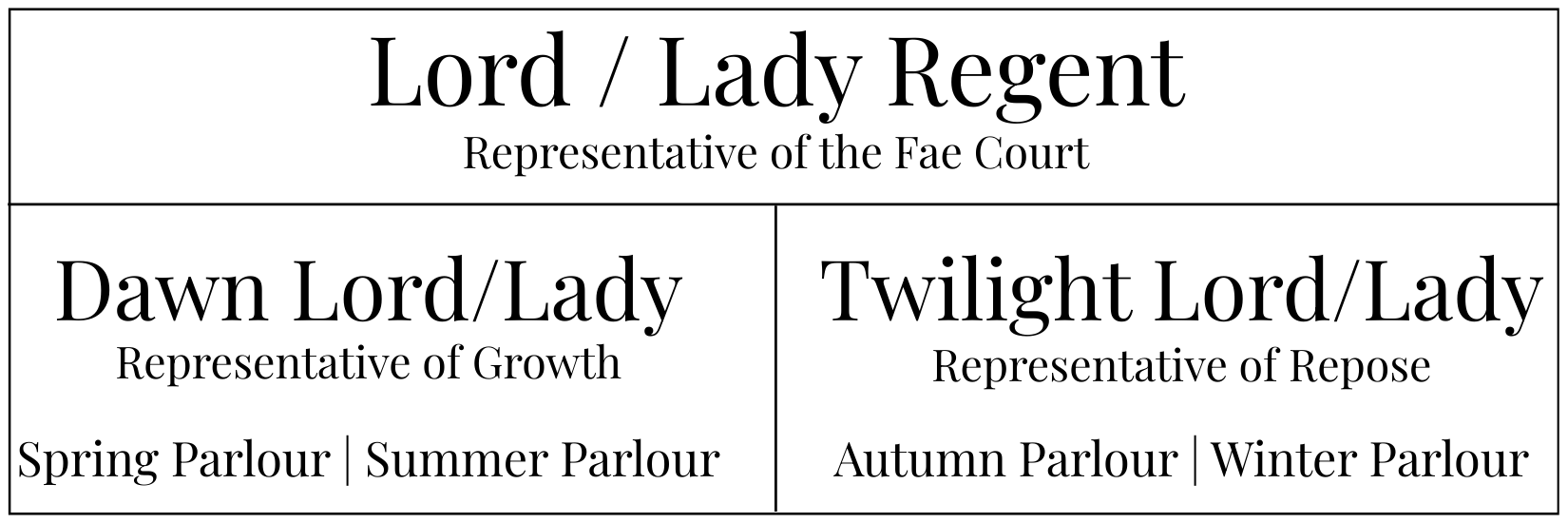
Lord / Lady Regent
The Regent of the Eclipse Ridge Fae Court is not a ruling position, but instead an advisor and arbitrator, overseeing the Court and acting as its voice in matters beyond. The Regent organizes and controls the flow of Court gatherings, offering advice and ensuring that all voices are heard in the decision making processes. This role is typically held by an Elder Fae, often one who has experience from before the collapse of the Slighe, whose life experience lends them a wisdom that they can offer to the Court without Seelie/Unseelie bias.
They hold a single vote, equal to all other voices in the Court, but can act as a tie-breaker when a consensus cannot be reached within the Court.
The Regent is also the representative of the Fae Court in dealings with other species, responsible for negotiating the needs of the Fae, while also protecting Fae interests.
Dawn Lord / Lady
The Dawn Lord / Lady is the representative of the Parlours of Growth in Eclipse Ridge, acting as the voice and arbitrator for the Spring and Summer Parlours. In their role, they are responsible for understanding the needs of the Fae they serve, bringing concerns and requests to the Court for discussion. They are also responsible for arbitrating issues among their Parlours, escalating them to the Court where necessary. This role is appointed by the Regent and is typically held by a Fae with a strong and long-standing presence in the Fae community.
Twilight Lord / Lady
The Twilight Lord / Lady is the representative of the Parlours of Repose in Eclipse Ridge, acting as the voice and arbitrator for the Autumn and Winter Parlours. In their role, they are responsible for understanding the needs of the Fae they serve, bringing concerns and requests to the Court for discussion. They are also responsible for arbitrating issues among their Parlours, escalating them to the Court where necessary. This role is appointed by the Regent and is typically held by a Fae with a strong and long-standing presence in the Fae community.
The Seasonal Parlours
These groups are the heart of the Fae community in Eclipse Ridge. While they have no formal structure or leadership, the Parlours are a means for addressing the needs and concerns of specific Ràithean and bringing them to the attention of their Representatives, who can then bring them to the attention of the Court if needed. The Parlours also play a role in celebrating the Solstices and Equinoxes, each Ràithean taking the lead for their connected event.
In times of need, the individual Parlours may be called on by the Court to assist with specific tasks, tailored to the skills of the Ràithean they represent.
In Eclipse Ridge, every Fae has a voice in the Court. When the population is low, Lords and Ladies of the Parlours are welcome to speak in Court gatherings; while in times of higher populations, the Parlours may be invited to speak in Growth / Repose gatherings beforehand, then have their needs presented by their Representatives at the larger Court.
For how to get involved please see Fae Lead Tavaera Vesperti (syerrafaolchu).
Characteristics
Fae will often align to chaos and order based on their inherent desires. They may seek isolation for personal reflection or form social groups for companionship. Additionally, there might be a desire to explore and wander or a preference for settling down and establishing roots.
Known for their mischievous nature, the Fae frequently engage in trickery, often using it as a means of imparting significant life lessons or for their own entertainment. In their inherent curiosity and exploratory nature, Fae creatures possess an irresistible urge to poke, ponder, and pinch objects that ignite their fascination.
Fae are particularly guarded about their true name, as uttering a fae’s true name establishes a connection that binds them to fulfill the promises made by the individual who possesses that knowledge. Some fae prefer to adopt a second name or nickname with which they will introduce themselves. On rare and trusted occasions, they may share their true name with someone they trust. (See: Vulnerabilities)
Appearance
The world of the Fae is vast, varied, and deeply rooted in countless myths, cultures, and interpretations. We recognize that there are many types of Fae and many ways they may appear, behave, or express their magic. Our goal is not to limit creativity but to ensure that all characters can exist coherently within the shared world of Eclipse Ridge.
Fae wield innate glamour, often reinforced through runes, allowing them to alter their appearance at will, including aspects such as sex and gender. However, this power is not limitless. From birth, every Fae develops a natural limitation: they can maintain only three stable appearances. Maintaining too many forms fractures the glamour and risks exposure.
Fae appearances are designed to pass among humans, but minor anomalies are not uncommon. A sharpness to the ear, irises of unnatural hue, or hair touched by colors not found in nature may occasionally surface beneath the glamour. These traits persist within acceptable human variance and can be readily explained through cosmetic surgery, contact lenses, dyes, or styling tools.
The Fae in Eclipse Ridge have a strong affinity for body art, often sporting tattoos. These complex designs are more than decorative; they act as a disguise for the runes that the fae use to sharpen their innate abilities, effectively hiding them within the ink.
True Form
A Fae’s true form is not merely a physical shape, but an expression of their deepest magical nature. Maintaining a humanoid or mortal-adjacent guise requires focus, discipline, and control, something most Fae master early in their existence.
True forms are allowed in a Fae’s private residence, designated Fae-only areas, or approved storylines where true form use is narratively justified.
While Fae appear in many shapes and traditions, all Fae within Eclipse Ridge are bound by shared metaphysical pressures and social consequences. True form s are a storytelling tool, not a cosmetic toggle. Repeated or sustained public use without a narrative cause should carry escalating in-character consequences and, if problematic, out-of-character consequences.
Guidelines for True Form
- True forms should have a humanoid appearance, but are allowed elements to express their Fae classification, Ràithean, or captivating otherworldly allure. Fae may draw inspiration from folklore or mythic beings, but their true form must always retain a bipedal, anatomically sound, humanoid silhouette.
- If you have a form that is not the above, but you believe will still fit in with the lore and restrictions, please open a ticket!
- Flying is allowed if your true form has wings.
- Please be cautious of prim count and heavy script usage in your true form that could contribute to lag issues
- The Shroud still applies so be aware where and when you reveal your true form.
Fae and the Lode
Believed to originate directly from the source of the Lode, Fae act as conduits, allowing them to harness and store this power within themselves. Fae are born with inherent magical abilities, which are an essential part of their nature, unlike witches, whose innate magical powers develop in childhood. Fae are steeped in the Lode. If a Fae tries to use a gem or use it to boost abilities, it will overload, crack, burn out, or even lash back in an uncontrolled surge. Left unbound, Fae magic behaves like weather: wild, sudden, and heedless.
Attunement
Your Fae’s origin, culture, and identity matter. However, all supernatural beings within Eclipse Ridge attune to the Lode, and their magic manifests according to the Lode’s rules while they are in the region.
The Lode is not a faction, belief, or spell system – it is a regional constant, like gravity or atmosphere.
When a Fae enters Eclipse Ridge, their innate magic synchronizes with the Lode’s frequency, shaping how it can safely and reliably manifest. Attunement does not change a Fae’s origin, personality, court, or true form.
It only determines how their magic is expressed while within the Ridge. No type of Fae is stronger or weaker by default in Eclipse Ridge. Power differences emerge from choices, consequences, preparation, and narrative – not origin.
The Lode assesses both the individual and the land, shaping their body and magic to serve where the need is greatest.
The Ráithean of Fae
Every Fae belongs to a season or Ràithean (RAH-yun), a primal alignment that governs how their magic interacts in this realm.
A Fae’s Ràithean determines your innate magic, tied to the elements. These are always accessible, reflecting your body, instincts, and soul.
Most Fae manifest their Ràithean early in life, often, though not always, mirroring the season of their birth. This alignment governs how their magic flows, what environments empower them, and where they are most vulnerable.
When a non-native Fae enters the region, it triggers an innate alignment: the Lode assesses both the individual and the land, shaping their body and magic to serve where the need is greatest.
(Note: Players do get to decide. This merely explains how your Fae synchronizes with the Lode’s frequency if they are not native to the region).
Ráithean Structure
| Season | Element | Solstice/Equinox | Emodies |
|---|---|---|---|
| Spring | Earth | Ostara | growth, stability, restoration |
| Summer | Fire | Litha | passion, force, and momentum |
| Autumn | Air | Mabon | change, knowledge, inevitability |
| Winter | Water | Yule | stillness, decay, reflection |
In addition to their Ràithean, each Fae expresses their power through secondary abilities known as Rune-bound. Rune-bound allows the Fae to manipulate ideas, bodies, reality, or absence. Unlike Ràithean abilities, they require runes or court cooperation to use fully.
Rune-bound Abilities
The following table shows each category and the attributes they embody.
| Mental | Physical | Cosmic | Void |
|---|---|---|---|
| perception, emotion, and memory | force, speed, and density | divinity, luck, and space | absence, suppression, and erosion |
Each Fae has one Ràithean and one Rune-bound. A Fae’s Ràithean always takes precedence. Rune-bound are your reach, your way to affect the world beyond your natural element.
To access Rune-bound spells you must have at extension rune. Extension runes stretch the limits of a spell, increasing its reach, duration, or influence beyond what the Fae could safely achieve unaided. This is required to access your rune-bound spells.
Runes
When the portal to their realm closed, the Fae’s direct connection to the Lode became increasingly erratic, inconsistent, and challenging to wield. To counter this, Elder Fae began adorning their skin with runes to express magic that already exists within them, shaped by runes rather than fueled by external power sources.
Runes tattooed, embedded, or infused onto a Fae function as living grounding circuitry rather than inert markings. They channel and regulate magical flow, reinforcing focus, discipline, and the filtering of intent. Acting as anchors, these runes help contain excess power and guide how magic manifests, without generating the magic themselves.
Over time, these runes shift, fade, or warp, just as the Lode’s flow bends and the Fae’s own flesh strives to heal over the channels. To preserve clarity of power and prevent wild surges, Fae maintain their runes during Solstice and Equinox. Without properly maintained runes, a Fae’s power becomes volatile – bleeding into their surroundings, exposing their true nature, and drawing unwanted attention from hunters, predators, or rival beings. (See: Vulnerabilities).
Rune Types
Extension
Extension runes stretch the limits of a spell, increasing its reach, duration, or influence beyond what the Fae could safely achieve unaided. This is required to access your rune-bound spells.
Anchor
Anchor runes bind magic to a fixed point, concept, or self, preventing spells from drifting, mutating, or unraveling under emotional strain.
Suppression
Suppression runes dampen or restrain magical output, allowing a Fae to mute volatile power, stall unwanted effects, or prevent magic from manifesting at all.
Grounding
Grounding runes draw excess magic back into the Lode or the physical world, stabilizing the Fae’s body and mind and reducing backlash from overexertion.
Alternate Ràithean Access
While a Fae’s Ràithean is biologically fixed, rare circumstances may allow a Fae to briefly draw upon another Season’s influence. A Fae may momentarily borrow another Ràithean’s influence, but they can never inhabit it. Such access is never natural and is always unstable.
Temporary seasonal access does not grant full authority over another Season, nor does it replace a Fae’s prepared abilities. Instead, it allows limited, short-lived effects shaped through the Fae’s original alignment.
This practice places significant strain on Fae. Backlash, rune instability, and environmental disturbances are common, and repeated attempts can disrupt local Lode flows, disturbances that witches are capable of sensing. (See: Fae Spell Repertoire for details)
Permanent Change to Ràithean
While rare, a Fae may attempt to realign their Ràithean. Such a change can only be undertaken during the Fae’s new solstice/equinox or with the help of a court. Because it stands in direct opposition to this realm’s natural balance, the process is physically and magically destabilizing, requiring extensive rune-work to suppress backlash, and takes up to about three months (equal to a season). Until that time, the new Ràithean only works at 75% as the old one drains out.
A Fae who actively works against their natural Ràithean does not merely endanger themselves. Persistent imbalance disrupts seasonal flows within the Lode, creating disturbances that witches are capable of sensing.
To defy one’s Ràithean is to strain the ecosystem of magic itself and nature, or the Lode, does not tolerate imbalance indefinitely.
How to Use the Lode
Fae and Witches both operate under a three-tiered system, but they do so independently. Fae channel magic from within, while Witches shape it externally. While some parallels exist, Fae maintain their own unique set of spells and abilities. If there’s a spell or ability you wish to use that isn’t listed, please submit a ticket.
The Tiers
Tier I: Ráithean-bound
Always accessible, requires no external tools. Simple, short-term, or subtle effects. Fae can rely on these without preparation and give full access to seasonal traits and abilities, as well as glamors and cloaking.
Tier II: Rune-bound
Requires focus and intention. Runes are used to amplify effects, allowing control over distance, duration, or intensity. An Extension Rune is required to gain access to this tier of spells.
Tier III: Court-bound
Collaborative; reality-altering; high consequence. Some effects are too vast or unstable for one Fae alone. These require ritual, alignment with the Lode, or shared effort with Witches.
Ráithean Abilities
These innate abilities are elemental expressions, not formal spells. Each ability can take many forms. If your expression may impact other players, please obtain out-of-character consent first. Any expression that affects the sim itself – such as businesses, municipalities, or state park requires staff approval through a ticket submission.
Spring
Element: Earth
Focus: Terrakinesis
Terrakinesis is tied to emotional equilibrium, reflecting the steady heart of the Lode itself. When centered, the earth responds with generosity, allowing them to nurture growth, reclaim barren spaces, reshape terrain, or raise barriers of stone and clay. It draws strength from balance rather than chaos, mirroring how forests grow and mountains endure over time. Terrakinesis is an act of restoration rather than erasing harm called forth for recovery, resilience, and renewal.
Summer
Element: Fire
Focus: Pyromancy
Pyrokinesis allows them to ignite flames, manipulate heat, or create sparks of illumination or protection. Fire is the pure expression of passion, answering not just intent but intensity. With sufficient force, it becomes reshaping, a tool of transformation and creation. Unchecked, it can leap, scorch, or burn unexpectedly. Mastery of this element demands self-awareness, for the fire reflects the heart as much as the hand.
Autumn
Element: Air
Focus: Aerokinesis
Aerokinesis can create gentle breezes, powerful gusts, or subtle currents that carry messages or conceal movement. This element favors freedom and intuition, answering gestures and focus, yet it is bound to inevitability: once set in motion, the wind must travel somewhere, and its consequences cannot be recalled. Misalignment of thought or intent may stir storms or dissipate the wind entirely, showing that even the air bends only to those who move in harmony with it.
Winter
Element: Water
Focus: Hyrdomancy
Hydrokinesis is an art of quiet command rather than force. Water answers them in silence, memory, and mirror-smooth reflection. Their power is strongest in stillness; when the self is calm, the water settles into perfect obedience, protecting, preserving, and holding shape. Impatience or emotional strain disrupts this quiet accord causing the water to hesitate, spill, or surge without direction.
Visit the Fae Spell Repertoire for the full list of spells for each Ráthiean.
Rune-bound Abilities
A Ráthiean is the core of the Fae’s power. Rune-bound spells, by contrast, extend a Fae’s reach giving them the ability to influence aspects of the world that their Ráthiean alignment does not touch.
Even when a Fae attempts a rune-bound effect, their Ràithean nature may override it if the spell conflicts with their elemental instincts or the Lode’s guidance. Rune-bound magic is flexible, experimental, and precise but it must operate in concert with the Fae’s Ráthean, never against it.
Visit the Fae Spell Repertoire for the list of Rune-bounds spells.
Abilities
Immortality
Fae immortality is complex. They can be killed (e.g., body destroyed, banished), but they do not decay naturally, and time alone does not claim them. Some Fae may “fade” rather than die if cut off from magic or purpose.
Cloaking
Confined to this realm, Fae have naturally evolved the means to move unseen among humans. Among their most subtle talents is Cloaking—the instinctive ability to shift their appearance, soften their presence, or even alter gender. This power flows through them, a reflection of their essence rather than a learned skill. Runes serve only to focus or sustain it, helping the Fae maintain more elaborate forms or extend their concealment, but the magic itself arises from within. Please note: Up to 3 appearances are allowed and must remain consistent. Fae are not allowed to use the appearance of an established character or mimic creatures and animals (animal shifting is reserved for our Cinnidh species).
True Form’s Embrace
A Fae’s true form is their home and familiarity, thus their form dictates the abilities that can physically manifest. They are able to use the unique appendages, and bodily variety for their realistic uses. I.e. Wings will offer the innate ability to fly, extra arms will be able to be used freely, tails will be able to encourage and assist with balance, etc. (OOC Note: Ensure you abide by the True Form stipulations advised previously.)
Lode Detection
Because the Lode flows through them, Fae can instinctively sense the presence of Witches, feeling the pull of their magic as a subtle vibration in the air or a weight in the land. They are also sensitive to strong workings, able to smell lingering spell residue or feel disturbances echoing through the Lode itself, bound as they are to its currents. Yet in a gathering of many, this perception can blur, making it difficult to discern which individual wields the Lode and which merely walks nearby.
Admin note: Fae players need to get out-of-character (OOC) consent from their target. They must then collaborate with the target to determine how the “truth” is perceived in the instance of if the target possesses a charm that conceals identity or truth.
Lode Wielding
Fae do not “cast spells” the way witches do. They express magic that already exists within them through seasonal alignment or shaped by runes that help stabilize and concentrate the Lode in their spellwork. Fae maintain their own unique set of spells and abilities. Please see How to Use the Lode for full details.
Vulnerabilities
Disembodiment
Although the Fae are immortal and could potentially live forever, they can be killed through external forces. The Fae share physical vulnerabilities in the fact their body can be destroyed, and magical vulnerabilities in the fact their essence can be banished.
Glamour Glitch
Fae are the embodiment of the lode, making all their magic attuned to themselves. They are rarely subtle casters, and in reflection, they are powerful casters. When fae begin to cast higher cost spells, their glamour begins to wane as their focus and power is shifted towards the spell. This causes their glamour to begin to flicker and hints, glimpses, and aspects of their true form begin to show. This is very threatening to the lode and encourages such spells to be done in far safer places.
The Glitch is intensified when there is a Full Moon as the Full Moon reflects the sun the greatest. The Fae’s power is thus deeply enhanced due to the elements being at their highest, causing the Glamour Glitch to take its full effect and make Glamour nearly void on the Full Moon. Conversely, on the New Moon, this allows the Glitch to be nulled on the New Moon, as their shroud is far more balanced and allows for far more powerful spells to be cast without their true form coming through.
Iron
Iron serves as a protective element or talisman against the enigmatic Fae. It is believed that Fae may harbor a strong aversion to iron and can even sustain harm from its direct touch. They may be burned by it, die by an iron weapon, or be unable to cross under an iron horseshoe. Today, most “iron” products are actually made from steel, which is an alloy of iron with carbon, and makes common items tolerable to Fae.
- Pure iron or “cold iron” is iron produced before the 20th century with less than 1% carbon. That means that items made of pure iron are brittle and aren’t something that would be used on a daily basis.
- Wrought iron and cast iron can cause mild to moderate irritation with prolonged external exposure. But being used to slice or stab can be akin to silver poisoning for a Werewolf or Vampire and must seek medical and magical intervention.
- Steel has no effect on the Fae because they have built an immunity to the trace amounts found commonly throughout the world. However, high concentrations such as wrought iron, cold iron, ore, and other forms of concentrated irons will affect the Fae, including iron supplement vitamins.
- Iron fortifying in foods and other items will not poison Fae.
True Name
A Fae’s True Name is a potent weakness. If a human or other supernatural discovers this name (whether through ritual, deceit, inheriting ancient grimoires, or old pacts), they acquire significant leverage over the Fae. This knowledge grants limited power, allowing the possessor to compel the Fae’s obedience, enforce a binding contract, or even completely ward the Fae away from a specific location or individual. In fact, merely threatening to speak the True Name aloud is often sufficient to force the Fae into a full retreat.
Oaths, Promises, and Spoken Intent
Words spoken with intent carry binding force for the Fae. If a Fae voluntarily agrees to a promise, especially one spoken aloud, witnessed, or sealed by ritual, it becomes a metaphysical law to them. Breaking such an oath causes immediate spiritual and magical backlash.
When a Fae aids a mortal in breaking, weakening, or circumventing the oath or bond of another Fae, Witch, or Vocatis, they are not merely betraying an individual; they are defying the structure that allows magic to exist at all. Consequences can include, but are not limited to, being unable to speak certain words truthfully, becoming magically compelled to uphold others’ oaths against their will, or Court censure.
If a Fae’s oath or promise is broken, there is a potential of physical, social, and magical ramifications. A Fae must bring the break to the Court, and only the Court can consider the Oath fully null and void, thus freeing the fae from the oath. There is a potential of breaking a Fae’s Oath or Promise will be brought to the court and the one at fault will be named an Oathbreaker, which may have deeper social and magical ramifications.
Rune Stability
When a Fae pushes too much power through their runes without rest, recharge, or repair, the runes begin to fail not quietly, but biologically. Ignoring the care of runes can look like:
Strain
This condition typically manifests following prolonged or excessive use of a rune. Symptoms include fatigue, irritation around the rune site, and the potential for minor misfires if the rune is not sufficiently rested or recharged.
Fracture
This will happen when failing to properly prepare, recharge, or repair runes before use will result in consequences such as rune cracking, emotional instability, and a partial inability to access the rune’s power.
Failure
Failure among the Fae results from repeated violations of their nature, specifically through the overuse of runes belonging to a Ráithean other than their own, or by breaking binding oaths (whether made by themselves or on behalf of others) without the explicit agreement of all involved parties. The consequences of failure can include permanent rune scarring, which renders the affected area unusable, twisted physical manifestations, or an inability to stabilize the Lode, plunging the Fae into unpredictable chaos.
Special Note:
A big thank you to our R&D Department for helping with the development of our new spells and our Fae Lead for helping with the organization of the Fae Court.
 Eclipse Ridge